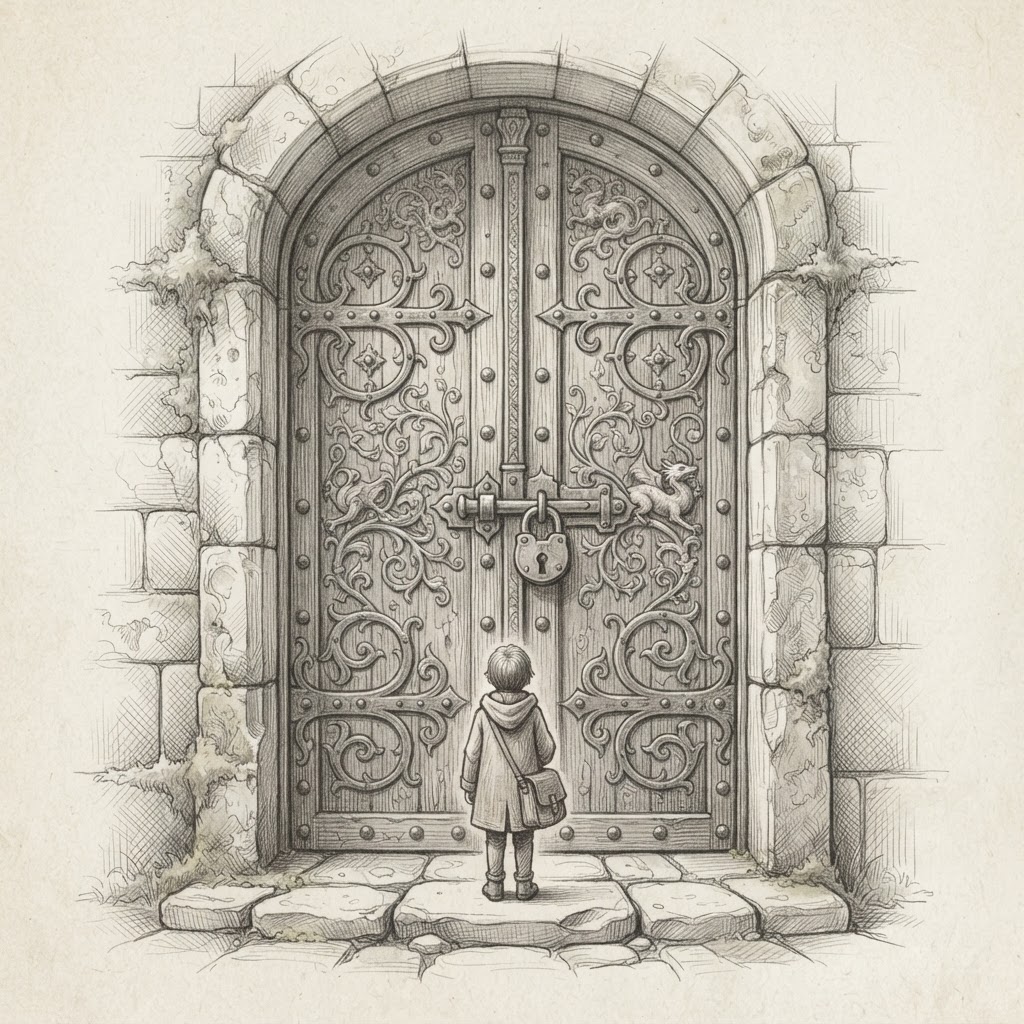
Most Small Business Owners Don't Lack Potential. They Lack Access.
What twenty years of building for small businesses taught me about the narrow distance between potential and possibility.
I started my first business almost by accident when I was 21.
I made almost every mistake available to me. I invested in the wrong things, set the wrong priorities, made the wrong assumptions, and took decisions without fully understanding what they would mean.
Eventually, I sold the business, and my mother told me it was time to find a real job and learn how the world actually worked.
What neither of us understood then was that the business had already shown me the problem I would spend the next twenty years trying to solve.
When you run a small business, you do not get the luxury of specializing.
You become the product person, the marketer, the salesperson, the strategist, and the operator, whether you are ready or not. There is no structured onboarding. There is no experienced colleague down the hall who has seen the problem before and knows what to do.
I started as a programmer. I became a marketer because I could not afford to hire one.
Google was new. SEO was new. Paying an expert was not an option, so I taught myself at night, not always very well at first.
Not because marketing was my calling. Because the alternative was that the business would not survive.
Years later, when we built WiseStamp, I found myself returning to the same problem from a different direction.
The idea was simple: give a micro-business a way to create a basic professional presence for one hundred dollars.
Before paying for a logo. Before building a website. Before taking on all the expenses that usually come with starting a business.
I wanted a new business owner to be able to create a professional email signature, send a proposal, and feel more confident in the way she presented herself to the world.
It may sound like a small thing. Just an email signature.
But when you are starting out, small things can change the way you see yourself.
You should not have to wait for a large budget, a team, or a perfect brand before you can begin to feel like a real business.
Looking back, I do not think people were paying us only for an email signature.
They were paying for the chance to look a little more like the business they were trying to become.
As WiseStamp grew to serve millions of businesses and tens of thousands of paying customers, I began to understand how deep the difficulty of running a small business could be.
Again and again, I saw the enormous gap in knowledge, resources, and possibilities between a small business and a large company.
A large company has people to consult. It has a budget for testing ideas. It has the time and room to recover from mistakes.
A small business has almost no margin for error.
One decision made too early, one expense at the wrong time, or one investment in the wrong place can be the difference between a business that keeps growing and a dream that stops.
The distance between a business owner and the life she is trying to build can look enormous.
In practice, I learned that it is sometimes very thin.
Sometimes all that separates a business that moves forward from one that gets stuck is a single decision, one piece of advice, or one person who knows when to say: not that. Not yet. Do this first.
Looking back, WiseStamp was my first attempt to narrow that distance.
We took something a larger business could easily buy and made it accessible to someone who was only beginning.
Over the years, I also met personally with hundreds of small business owners. I tried to understand their challenges and help where I could.
The same pattern appeared so consistently that it stopped feeling like an observation and started feeling like a rule.
The potential was there. The motivation was there. The ability was there too.
What was missing was something larger companies barely have to think about: access to people who know how to help.
Access to a marketing expert who knows where the budget should go. To someone who can build a business plan, understand the numbers, plan a budget, or spot a mistake before it becomes expensive.
Access to someone who has watched dozens of businesses face the same problem and can say: not that. Not yet. Do this first.
The owners who struggled were not less capable than the ones who succeeded.
Often, they simply had no one to ask.
A small business rarely has the budget for a specialist in every field, let alone an entire team of them. Large companies buy this knowledge through whole departments. Small business owners have to learn everything themselves, while they are already doing the work, often paying for the lesson through their mistakes.
At some point, I began asking myself:
How many businesses really fail because their owners lack ability?
And how many fail because they did not have the right person to ask at the right moment?
Perhaps we attribute too much success to talent, and too little to access: access to knowledge, experience, and people.
Then AI arrived.
The more I worked with it, and the more capable it became, the more I began to see the bridge I had been looking for all those years.
A bridge between small business owners and the knowledge, experience, and advice that had previously been available mainly to larger companies.
The potential is real.
We can connect the everyday questions of running a business with knowledge that can help. We can make expertise in marketing, finance, planning, and decision-making more accessible. We can give a business owner somewhere to bring a real question and receive help shaped around her business, her situation, and what she is trying to achieve.
But we are not there yet.
Access to an AI tool is not the same as access to expertise.
To get real value from it, you need to know what to ask, how to judge the answer, and how to turn it into the right decision.
Someone who already understands marketing, finance, or strategy knows how to use AI to go further.
Someone who does not may receive an impressive answer without knowing whether it is right for the business at all.
There is still a great deal to build.
We need to connect the technology to the real problems business owners face. We need to make it accessible, teach people how to use it, and translate all that power into help they can actually act on.
The capability already exists.
The challenge now is to turn it into a bridge a small business can actually cross.
My dream has never really been about technology.
It has been about people being able to create opportunities for themselves. To build something of their own. To earn a living from something meaningful. To gain a little more freedom over the shape of their lives.
With WiseStamp, we tried to give a small business a way to look professional before it had the budget of a large one.
Today, I am trying to make something deeper than another tool accessible: knowledge, experience, advice, and support that only a larger company could once afford.
Somewhere to bring a question. Help with a decision. The chance to stop feeling that you have to know and do everything alone.
In that sense, my entire career has been trying to answer the same question:
How do we give a small business capabilities that only larger companies could once afford?
Once, I tried to answer that question through software.
Today, I am trying to answer it through AI.
Over the past year, I have been building and testing different ways to make that possibility real. The work keeps raising questions, insights, and challenges that do not always have clear answers.
In this publication, I will share what I am learning along the way.
I will write about small businesses in the age of AI. About human beings in a world that is changing faster than our ability to understand it. About building products that genuinely help people and businesses, rather than merely impressing them. About the gap between what technology promises and what people actually need.
I will also write about the decisions, the mistakes, and the questions I still do not have answers to.
Because sometimes the questions we choose to keep pursuing matter just as much as the answers we find.
The technology has changed.
The dream has not.
The size of a business should not determine the size of its possibilities.